http://www.tripadvisor.com/ShowTopic-g187147-i14-k3423160-l24537471-The_Disneyfication_of_Montmartre-Paris_Ile_de_France.html
http://www.virtualtourist.com/travel/Europe/France/Ile_de_France/Paris-99080/Tourist_Traps-Paris-Street_Artists-BR-1.html
http://www.schoolvoorjournalistiek.com/europeanculture09/?p=664
http://www.sprachcaffe.com/english/study_abroad/countries/france/typical_french_traditions.htm
http://www.kwintessential.co.uk/resources/global-etiquette/france-country-profile.html
http://www.louvre.fr/llv/musee/mission.jsp?bmLocale=en
http://en.wikipedia.org/wiki/Culture_of_France
http://www.montmartreparis.com/things-to-do/culture
http://www.travour.com/tours-to-france/culture-of-france/
http://www.brighthub.com/education/languages/articles/8217.asp
http://en.wikipedia.org/wiki/Basque_people-indigenous
http://wiki.answers.com/Q/What_is_France_known_for
http://media-cdn.tripadvisor.com/media/photo-s/00/17/b6/f9/sacre-coeur-at-montmartre.jpg
http://en.wikipedia.org/wiki/Gourmet
http://gofrance.about.com/cs/parisforcouples/a/parisforlovers.htm
Thursday, December 9, 2010

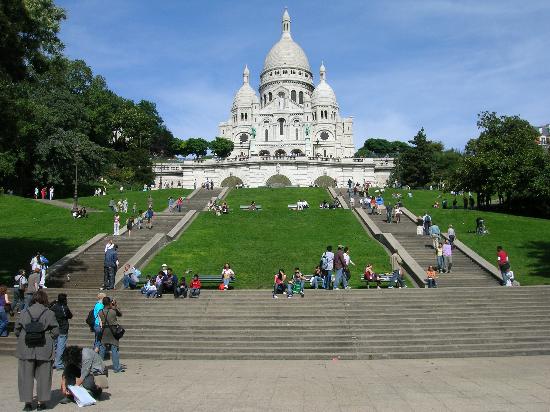
Has Tourism Been a Culprit in the Commodification of Montmartre?
My answer would have to be a definite yes. As mentioned in the previous post, the image of Montmartre has been commodified to be just a painting, or even worse the image of the Eiffel Tower. Something that has no part of Montmartre's culture. In addition, the current 'artists' has put great shame on the great artists who lived and had a life there, and are the people that brought Montmartre to the eyes of the world. Montmartre is now nothing more than just a tourist trap, it has lost its shine of what made it a great place.
In the long run, I fear that the growth of tourism would lead to even greater commodifications, not just in Montmartre, but all over the world. A simple reason would be that the commodification of culture, through selling merchandise for example is a great way to make a quick buck. And especially for the poor folks in rural areas, selling handcrafted souveniers to tourists is a great source of income for them. Why would they choose to preserve their culture over commodifying it, if preserving it gives no immediate benefit to them?
With this, all I hope now is that the government takes a huge leap to educate the people in the importance of preserving one's culture. And as for the people in developing countries, government bodies can help them to improve their lives by providing them with job opportunities instead of leaving them to fend on their own. This would decrease the need for locals to commidify their culture by selling their handcrafts, etc, and hopefully cause a gradual decrease in commodifications.
Spotting Disney in France, Montmartre & Changes Brought About By Tourism
What had undergone disneyfication was the Place du Tertre in Montmartre. Place du Tertre was originally an artist's paradise as many great artists like Vincent Van Gogh and Pablo Picasso used to live there to do their artworks. But because of this rich art background, it has attracted many tourists over to visit the place. Hence, many people saw this as an golden opportunity and they flock there with the sole intention of making a neat profit by selling paintings to tourists.
If you visit Montmartre now, two main groups of 'artists' can be easily spotted.
The first group of artists would be the ones painting the same colourful and romantic image as tourists stand behind and marvel at it. This process is a part of disneyfication as these artists are the performative labour due to the fact that their work as an artist is now seen as a performance. Add on to the fact that the similar paintings give a very 'themed' feeling whereby the image of Montmartre is now reduced to just that popular one. Previously a land filled with inspiring artists are now filled with artists who only concentrates on painting that same image.
If you visit Montmartre now, two main groups of 'artists' can be easily spotted.
The first group of artists would be the ones painting the same colourful and romantic image as tourists stand behind and marvel at it. This process is a part of disneyfication as these artists are the performative labour due to the fact that their work as an artist is now seen as a performance. Add on to the fact that the similar paintings give a very 'themed' feeling whereby the image of Montmartre is now reduced to just that popular one. Previously a land filled with inspiring artists are now filled with artists who only concentrates on painting that same image.
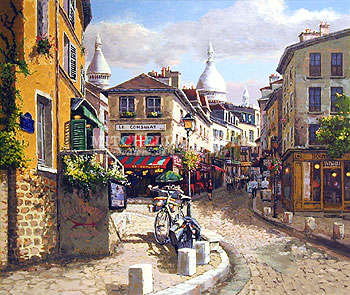
The next group of artists would be the scammers. The reason that they are scammers is because most of them are hardly 'artists' by nature and is only pretending to be one for the sake of ripping off tourists.
The following information I gathered was from www.virtualtourist.com, where real travelers gave their reviews on the place. Almost all the reviews there mentioned that these 'artists' would approach you and ask if they can draw you. But even if you turn them down, they would still continue drawing you. And when they are done with the drawing, they force you to pay them a ridiculous sum of money even though you showed no interest previously. Moreover, the paintings are horrible in most cases. But many people eventually give in and pay as they would not want to aggravate the situation. In one case, the 'artists' actually revealed that they actually play golf and tennis, which led the reviewer to believe that she was actually 'paying for their golf and tennis activities'.
This is the result that the growth of tourism has brought to the place. And these excellent words from Tourette, an artist living in Montmartre perfectly sums up this point. 'Montmartre is no longer about free spirit and creativity. It’s more than just chasing a dream; it’s all about business.'
Moving on, another disneyfication that has taken place is theming and merchandising. There are a number of merchandise shops in Montmartre. And the main merchandise they are selling is the brand of the 'Eiffel Tower'. Key chains, T-shirts, caps, figurine etc are all commonly seen. In fact, it is also not surprising to see tourists walking around Montmartre with the Eiffel Tower spotted on their shirt. The image of Eiffel Tower has no relation with Montmartre, specifically Place du Tutre where it is (was) a home for the artists. Hence it is edvident that theming has occurred. Furthermore, the selling of the Eiffel Tower branded goods in Montmartre is a result of merchandising.
The following information I gathered was from www.virtualtourist.com, where real travelers gave their reviews on the place. Almost all the reviews there mentioned that these 'artists' would approach you and ask if they can draw you. But even if you turn them down, they would still continue drawing you. And when they are done with the drawing, they force you to pay them a ridiculous sum of money even though you showed no interest previously. Moreover, the paintings are horrible in most cases. But many people eventually give in and pay as they would not want to aggravate the situation. In one case, the 'artists' actually revealed that they actually play golf and tennis, which led the reviewer to believe that she was actually 'paying for their golf and tennis activities'.
This is the result that the growth of tourism has brought to the place. And these excellent words from Tourette, an artist living in Montmartre perfectly sums up this point. 'Montmartre is no longer about free spirit and creativity. It’s more than just chasing a dream; it’s all about business.'
Moving on, another disneyfication that has taken place is theming and merchandising. There are a number of merchandise shops in Montmartre. And the main merchandise they are selling is the brand of the 'Eiffel Tower'. Key chains, T-shirts, caps, figurine etc are all commonly seen. In fact, it is also not surprising to see tourists walking around Montmartre with the Eiffel Tower spotted on their shirt. The image of Eiffel Tower has no relation with Montmartre, specifically Place du Tutre where it is (was) a home for the artists. Hence it is edvident that theming has occurred. Furthermore, the selling of the Eiffel Tower branded goods in Montmartre is a result of merchandising.

Finally, another impact of tourism in Monmartre is the case of an overload. The initial attraction of Monmartre was its scenic environment, gorgeous architects as well as the artistic background. And the concept of 'too much of a good thing can be bad' perfectly applies here. Too many tourists were drawn there and has resulted in and invasion of tourists. Every corner and street of Montmartre are filled with tourists. Hence, this has destroyed the beautiful image people once had of Montmartre. The swarm of tourists as well as the change in values of the artists brought about by the growth of tourism has been a letdown to many. Montmartre is no longer the place it used to be.
Leisure Programmes in France

There is a Nice Jazz Festivial which takes place in France anually since 1948, in the south of France. It draws in over 45,000 people each year, consisting of both spectators and musicians alike. Frommer's calls it the 'biggest, flashiest, and most prestigious jazz festival in Europe'. Due to the nature of jazz music, its soothing sounds may act as a medium for relaxation for its listeners. Hence, it is not surprising to find many locals and tourists heading down to the festival to enjoy its marvellous sounds.
France also hosts the French Tennis Open every year during the month of May in Paris. Only world renowned and highly skilled tennis players are able to participate and play in the Roland Garros stadium for up to two whole weeks. Many tennis fanatics who prefer to watch the action live rather than through the television will opt to go over to the stadium. There, spectators can get to sit back and watch their favourite players going head to head against other strong competitors.
France also hosts the French Tennis Open every year during the month of May in Paris. Only world renowned and highly skilled tennis players are able to participate and play in the Roland Garros stadium for up to two whole weeks. Many tennis fanatics who prefer to watch the action live rather than through the television will opt to go over to the stadium. There, spectators can get to sit back and watch their favourite players going head to head against other strong competitors.
 |
 |

Another popular form of leisure would be the locals playing soccer. As previously mentioned, soccer is the most played sport in the whole of France. Many of the French enjoys a good game of soccer during the weekends be it with their friends or families. Through the sport, values and stronger ties can be fostered, bringing the French closer together with one another.
Another popular form of leisure would be the locals playing soccer. As previously mentioned, soccer is the most played sport in the whole of France. Many of the French enjoys a good game of soccer during the weekends be it with their friends or families. Through the sport, values and stronger ties can be fostered, bringing the French closer together with one another.
 |
| French Kids Playing Soccer |
 Next up is the Tour de France which is held in France and surrounding countries. It is a annual bicycle race and one of the most famous ones in the world. This race attracts teams of cyclers not just from France, but from people all over the world too. The race is broken down into day-long segments, or stages in other words. Timings of the completed cyclers are aggregated to select the overall winner of the race. The course of the tournament has changed over the past few years, but it has always ended up with the finishing point in Paris.
 |
| The Race Kicks Off |
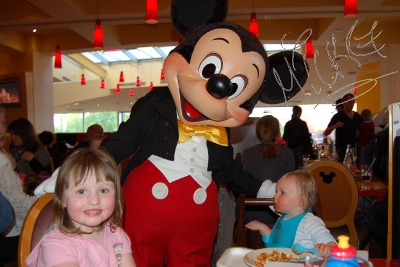
If you'rer intending to bring the family to Paris, then Disneyland Paris is definitely a must-go-to destination. There are many different themed parks, ranging from safari to amusement parks. Furthermore, many familiar favourites have been re-created there. Like the Arabian Nights, Pirates of the Caribbean, Treasure Island, etc. Anyone who goes there will be in for a day of fun-filled adventures and activities.



In general, there are actually many leisure activities to participate in France. They range from inland activities like golf, trekking, hiking, taking walks in the beautiful gardens and even climbing the Eiffel Tower. They also have off-shore activities like fishing, jet-skiing and canal boating.
Mode of Education in France
The French education system is remarkably organized, and quite similar to Singapore's education system, are divided into 3 stages. Primary education, secondary education and lastly higher education. According to the Programme for International Student Assessment, France's education system is ranked at 25th position in the world. This puts them at an average with regards to the ruling of the Organisation for Economic Co-operation and Development (OECD).The schools providing primary and secondary education are mainly public schools. As for the private schools, they are usually engaging in Catholic education. For higher education, France has further subset it into public universities and Grandes écoles. Grandes écoles has a selective screening for the admission of students. But in the case of public universities, as long as you obtained the baccalaureat (an academic qualification which French and international students take at the end of high school), you can get into the public universities.
The history of the development of the French education system was credited to Charlemagne (Charles the Great). However, the modern mode of education was revolutionised by Jules Ferry. He is a lawyer situated in the office of Minister of Public Instruction in the 1880s and also created the Republican school by making it mandatory for children below the age of 15 to attend school. This is pretty similar to Singapore's education of making it compulsory for children to at least graduate with a Primary School Leaving Examination (PSLE) certification.
The history of the development of the French education system was credited to Charlemagne (Charles the Great). However, the modern mode of education was revolutionised by Jules Ferry. He is a lawyer situated in the office of Minister of Public Instruction in the 1880s and also created the Republican school by making it mandatory for children below the age of 15 to attend school. This is pretty similar to Singapore's education of making it compulsory for children to at least graduate with a Primary School Leaving Examination (PSLE) certification.
 |
| Jules Ferry |

Languages of France
 France, just like many other countries, have multiple languages spoken in their country. Of course, the main language spoken and official language would be French. Due to people immigrating in from all over the world, quite a huge number of non-indigenous languages are also spoken now in France. The main immigrant languages are Portuguese, Spanish, Italian and Armenian (Indo-European). Whereas the main foreign language would be English.
The French government is by law, required to communicate mainly in French. Furthermore, it is compulsory for commercial advertisements to be in French too. However, for private individuals or corporations, as well as the media, are not mandatory to use French for their own personal advertising.

Indigenous Groups in France
The indigenous people in France would be the Basque people. They generally inhabit an area originally known as the Basque Country. It is a region set in between north-eastern Spain and south-western France. They therefore have a history intertwined with the Spanish as well as the French. On the other hand, the original of the Basque people has always been a mystery. There are many theories on the Basque people, but none of them has been generally accepted. The Basque language is also a one-of-a-kind, as it is branded an isolated language with no connection to other living languages. The Basque language is so exclusive that even not everyone with Basque blood in them can speak the language.
 |
| Modern Day Basque People |
 |
| Olden Day Basque People |
According to the book 'The Basque History of the World' (New York: Penguin Group, 2001), the Basque people has a trait that we should all learn from. That trait is that they have the capability to conserve their past memories and heritage while continuously progressing in the world. This allows the Basque to widen their cultural heritage. An example would be the gold-rush days in the 1800s. There were a group of Basque who immigrated to the Northern Nevada area in the hope of striking gold. After they came to the realization that it was extremely difficult to find any gold, they came to their senses and went into sheepherding. Over the years, sheepherding has gradually lost its potential to reap profits. They then again moved on with their lives and went in search of other job opportunities. Even though they had left their sheepherding jobs, they still remember it and celebrated over the era of this history.
 |
| Basque Sheepherder |
 |
| Gold Rush in Nevada |
Subscribe to:
Posts (Atom)